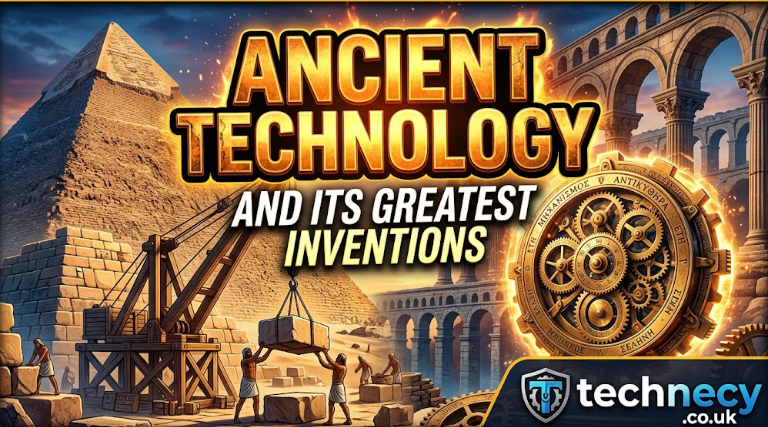
Ancient technology reveals a side of human history that is often overlooked. Thousands of years before modern machines and digital systems existed, people were creating tools, structures, and methods that solved difficult challenges. Their inventions helped communities grow, improved daily life, and created the foundation for many ideas used today. From farming systems that supported early cities to engineering achievements that still impress researchers, ancient societies showed remarkable knowledge and creativity. They worked with limited resources but developed practical solutions through observation, experimentation, and experience.
What Was Ancient Technology?
Ancient technology refers to the inventions, tools, and techniques created by humans in early periods of history. It includes simple objects such as stone tools as well as complex systems used for construction, transportation, medicine, and scientific study. Technology in ancient times was closely connected to survival and progress. People needed better ways to produce food, build shelters, travel, protect communities, and share information. Each improvement helped societies become more organized and capable. Ancient technology was not about having advanced machines like those available today. Instead, it was about understanding materials, using natural resources wisely, and creating solutions that matched the needs of the time.
The First Tools and Human Ingenuity
The earliest technologies began with basic tools made from stone, wood, and bone. These objects allowed early humans to hunt more effectively, prepare food, and create safer living environments. Over time, people learned to improve their tools by changing shapes, selecting better materials, and developing new techniques. The discovery of fire control was another major step because it changed cooking, protection, and human settlement patterns. These early inventions may appear simple compared with modern technology, but they represented important moments in human development. Each tool showed an ability to observe problems and create practical solutions.
Agriculture Technology Created Permanent Communities
The development of agriculture changed human history. Before farming, many groups lived by hunting and gathering. Once people learned to grow crops and manage animals, they could establish permanent settlements. Ancient farmers developed tools such as plows, storage systems, and irrigation methods to improve food production. Water management became especially important in areas where rainfall was unreliable. Civilizations in regions such as Mesopotamia and Egypt built systems to control water supplies and support larger populations. These agricultural technologies allowed cities to grow and encouraged the development of trade, government, and specialized skills.
The Wheel and the Growth of Transportation
The wheel is one of the most recognized inventions from the ancient world. Although its early use was connected to pottery production, it later transformed transportation and mechanical design. Wheeled vehicles made it easier to move goods, materials, and people. Traders could travel farther, farmers could transport heavier loads, and communities became more connected. The importance of the wheel was not only in transportation. It introduced ideas about rotation and movement that later influenced many machines and engineering systems.
Engineering Achievements of Ancient Egypt
Ancient Egypt demonstrated advanced engineering abilities through its architecture, construction methods, and resource management. The pyramids and temples required careful planning, accurate measurements, and organized labor. Builders had to transport heavy stone blocks, design stable structures, and manage large construction projects without modern equipment. Egyptian technology also included medical practices, writing materials, agricultural tools, and methods for measuring time. Their achievements show that ancient technology covered many areas of life, not just monumental buildings.
Mesopotamian Innovations That Changed Society
Mesopotamia was one of the earliest centers of technological development. The people of this region created systems that supported some of the first large cities in history. One major achievement was writing. The development of cuneiform allowed people to record trade, laws, government activities, and knowledge. This changed how information was stored and shared. Mesopotamians also made progress in mathematics and astronomy. Their calculations helped with building, farming, and understanding natural cycles.
Greek Ideas in Science and Mechanics
Ancient Greece contributed many ideas that connected technology with scientific thinking. Greek inventors and mathematicians explored concepts related to motion, measurement, and mechanical systems. The Antikythera Mechanism remains one of the most fascinating examples of ancient engineering. This device used a complex arrangement of gears to track astronomical movements and demonstrates a high level of mechanical understanding. Greek engineers also studied levers, water movement, and machines that reduced human effort. Their work influenced later developments in engineering and science.
Roman Technology and Practical Engineering
Roman technology focused heavily on improving everyday life and supporting a large empire. Their engineers created roads, bridges, aqueducts, and public facilities that connected cities and improved living conditions. Roman roads helped trade and communication, while aqueducts delivered water over long distances. Their construction techniques allowed many structures to survive for centuries. Roman engineering shows how technology can be used not only for invention but also for managing large societies efficiently.
Ancient Chinese Inventions With Global Impact
Ancient China produced several inventions that changed communication, travel, and knowledge sharing. Papermaking provided a practical way to record information, while printing methods helped spread written material more widely. The compass improved navigation and allowed travelers to explore with greater confidence. Chinese engineers also developed scientific instruments and mechanical devices that reflected careful study of nature and physical principles.
Ancient Medicine and Scientific Observation
Ancient technology also influenced healthcare. Early civilizations developed methods for treating injuries, preparing medicines, and recording medical observations. Egyptian, Greek, Indian, and Chinese traditions contributed knowledge about the human body and natural remedies. Although ancient medicine was limited by the science of the time, it created important pathways for future discoveries. The ability to document and preserve medical knowledge was itself a major technological achievement.
Why Ancient Technology Still Matters
Ancient technology continues to interest researchers because it shows how humans solve problems under different conditions. Many early inventions were created with simple materials but required advanced planning and creativity. Modern engineers still study ancient construction methods, materials, and water systems. These studies can provide ideas for sustainable solutions and help explain how earlier societies achieved long-lasting results. Ancient technology also reminds us that progress does not always depend on the newest tools. Innovation begins with understanding a problem and finding a better way to solve it.
Conclusion
Ancient technology represents thousands of years of human creativity and problem-solving. Early civilizations created inventions that supported farming, transportation, communication, and scientific discovery. Their achievements prove that innovation is not limited to modern times. People have always looked for better ways to live, work, and understand the world around them. By studying ancient technology, we gain a deeper appreciation for the ideas and skills that helped build human civilization. The tools may have changed, but the desire to create and improve remains the same.