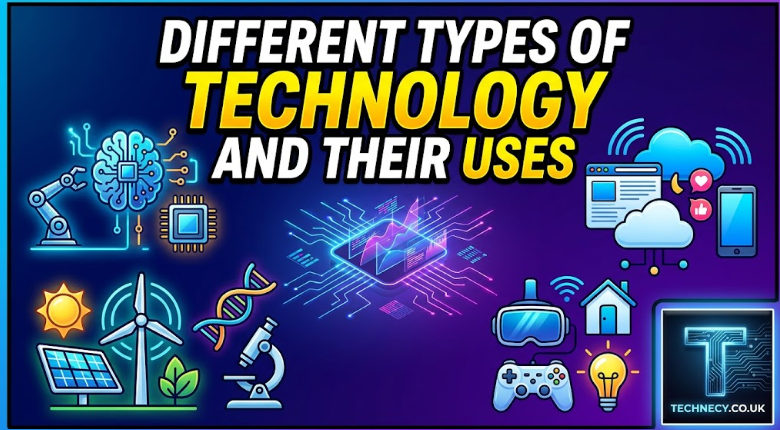
Technology isn’t limited to smartphones, computers, or the latest digital tools. It includes the machines that build cars, systems that deliver clean water, equipment doctors use to examine patients, and networks that allow people to communicate across continents. What connects these examples is a simple idea: people apply knowledge to create practical solutions. Understanding the different types of technology makes it easier to see how these systems fit into everyday life. Some categories focus on information and communication, while others deal with health, transportation, energy, farming, or production. The boundaries aren’t always strict, because a single product can combine several technologies at once.
What Is Technology?
Technology is the practical use of knowledge, skills, tools, and processes to achieve a particular purpose. A basic hand tool qualifies just as much as a sophisticated computer system. The complexity may differ, but both were developed to make a task possible, easier, safer, or more efficient. This broader definition explains why technology has existed throughout human history. Wheels, printing presses, engines, electrical systems, and computers belong to different periods, yet each changed how people performed important tasks. Modern technology builds on the same principle while often combining physical equipment with software and data.
How Technology Is Classified
There isn’t one universal list of technology categories. A practical way to classify them is according to what they do and where they’re mainly used. This gives us categories such as information, medical, transportation, agricultural, and energy technology. The categories can overlap considerably. An electric car, for example, combines transportation technology with battery systems, computing, communications, sensors, and software. Rather than treating each category as an isolated field, it’s more useful to understand its main purpose and how it connects with others.
Information Technology
Information technology focuses on creating, storing, processing, protecting, and exchanging digital information. Computers, servers, databases, business software, storage systems, and computer networks are common examples. Most modern organizations depend on these systems for everyday operations. Consider an online retailer. Its IT systems may keep customer records, update inventory, process orders, manage its website, and store business documents. Information technology often works quietly in the background, but many services would struggle to operate without it.
Communication Technology
Communication technology allows information to move between people, organizations, and devices. Smartphones, email, Wi-Fi, fiber-optic networks, radio, television, video calls, and satellite communications all belong within this broad category. The goal is to make communication possible regardless of distance. Digital communication has also reduced the distinction between communication and computing. Sending a message now involves a device, software, internet infrastructure, servers, and networking systems. What appears to be a simple conversation can depend on several technologies working together.
Artificial Intelligence
Artificial intelligence refers to computer systems designed to perform tasks that normally require abilities associated with human intelligence. These can include recognizing images, understanding language, identifying patterns, making predictions, and generating content. Machine learning is one of the main approaches used to build many current AI systems. AI already appears in familiar services. Search engines, recommendation systems, navigation tools, fraud detection, customer-support software, and voice assistants can all use AI in different ways. Its usefulness depends less on the label and more on whether a system performs its intended task accurately, safely, and consistently.
Medical and Health Technology
Medical technology supports the prevention, diagnosis, monitoring, and treatment of health problems. It ranges from relatively simple instruments to highly specialized hospital systems. Diagnostic scanners, laboratory equipment, patient monitors, surgical tools, prosthetics, and medical implants are familiar examples. Digital systems have expanded this category further. Doctors and healthcare organizations can use electronic health records, remote monitoring devices, telemedicine platforms, and software-assisted diagnostics. Because health decisions can carry serious consequences, medical technologies require particularly careful attention to safety and performance.
Energy and Power Technology
Energy technology deals with producing, storing, distributing, and managing energy. Power plants, electrical grids, generators, solar panels, wind turbines, batteries, and charging systems all fall within this area. Without energy infrastructure, most other modern technologies couldn’t function reliably. Energy storage has become especially important as electricity generation changes. Batteries can store electricity for later use, while smart systems can help balance supply and demand. These developments connect energy technology closely with computing, transportation, and environmental management.
Transportation Technology
Transportation technology helps move people and goods from one place to another. Cars, buses, trains, ships, aircraft, traffic-control equipment, and navigation systems are straightforward examples. Roads, rail networks, charging stations, and other supporting infrastructure are also essential parts of transportation systems. Modern vehicles increasingly depend on electronics and software as well as mechanical engineering. Electric cars use battery-management systems, while many vehicles include cameras, sensors, GPS, and driver-assistance features. Transportation has therefore become one of the clearest examples of several technology fields converging.
Manufacturing Technology
Manufacturing technology covers the equipment and processes used to turn materials and components into finished products. Assembly lines, industrial machinery, computer-controlled equipment, automated inspection systems, and 3D printers are widely used examples. Different industries adapt these technologies according to what they produce. Automation can handle repetitive or highly precise production tasks, but manufacturing still depends heavily on people. Engineers design processes, technicians maintain machinery, and quality teams check whether products meet required standards. The strongest production systems usually combine human judgment with appropriate machinery and software.
Robotics Technology
Robotics focuses on machines capable of performing physical tasks with varying levels of automation. Industrial robots can weld car components, move heavy materials, package products, or repeatedly assemble small parts. Other robots work in warehouses, hospitals, laboratories, farms, and locations that may be dangerous for people. A robot is rarely a single technology by itself. It may combine mechanical components, cameras, sensors, motors, control software, and AI. These combinations allow machines to detect their surroundings and respond to changing conditions rather than simply repeating one fixed movement.
Agricultural Technology
Agricultural technology applies tools and systems to farming and food production. Tractors, harvesters, irrigation equipment, greenhouses, and livestock-management systems have improved agricultural work for generations. Newer tools include agricultural drones, GPS-guided machinery, field sensors, and farm-management software. Precision farming takes this further by helping growers understand conditions in specific parts of a field. Information about soil, weather, crops, and water can support more targeted decisions. The practical value varies depending on the farm, crop, climate, available infrastructure, and cost of the technology.
Construction Technology
Construction technology includes the equipment, materials, methods, and digital tools used to build and maintain structures. Cranes, excavators, surveying equipment, power tools, prefabricated components, and specialized building materials are traditional examples. These technologies help construction teams handle tasks that would otherwise require far more time and labor. Digital tools are also changing project planning. Building models, drones, project-management software, and digital surveying can help teams understand sites and coordinate work before problems reach the construction stage. The aim is practical: better planning, safer work, and fewer costly errors.
Educational Technology
Educational technology uses tools and digital systems to support teaching and learning. Online courses, learning-management systems, interactive displays, educational applications, digital textbooks, and virtual classrooms all belong to this category. These tools can support both classroom education and remote learning. Technology doesn’t automatically improve education simply because it is available. Teachers still need suitable material, students need access, and tools must match the learning objective. A simple digital resource that helps students understand a difficult concept can be more valuable than an expensive system that adds unnecessary complexity.
Biotechnology
Biotechnology applies biological knowledge and processes to practical problems. It can involve microorganisms, cells, genetic material, enzymes, or other biological systems. Applications appear in medicine, agriculture, food production, scientific research, and industry. Examples range from fermentation and laboratory testing to biological medicines and genetic analysis. Biotechnology is a useful reminder that technology doesn’t have to involve computers or electronics. Applying biological science to create a useful product or process is technology too.
Environmental Technology
Environmental technology is designed to measure, prevent, manage, or reduce environmental problems. Water-treatment plants, recycling systems, air-quality monitors, wastewater equipment, pollution-control systems, and environmental sensors are common examples. Some technologies clean existing pollution, while others are designed to prevent waste or emissions. Monitoring is an important part of this field as well. Reliable information about air, water, soil, and weather conditions helps organizations understand where problems exist. Better measurement doesn’t solve an environmental problem by itself, but it can support better decisions about what needs to change.
Financial Technology
Financial technology, commonly called FinTech, combines financial services with digital systems. Mobile banking, electronic payments, online money transfers, digital wallets, automated financial platforms, and fraud-detection systems are everyday examples. Many financial activities that once required paperwork can now be completed through a phone or computer. Convenience brings additional responsibilities. Financial systems handle valuable and often sensitive information, making security, identity verification, privacy, and reliability essential. A payment service has little value if customers cannot trust it to process transactions correctly.
Space Technology
Space technology includes the equipment and systems used for activities beyond Earth’s atmosphere. Satellites, rockets, spacecraft, scientific instruments, space telescopes, ground stations, and exploration vehicles belong to this field. These systems often require specialized materials and engineering because they must operate under demanding conditions. Space technology also supports ordinary activities on Earth. Satellite systems contribute to navigation, communications, weather observation, mapping, and scientific monitoring. Someone using GPS on a phone is benefiting from space-based infrastructure without necessarily thinking about it.
How Different Types of Technology Work Together
Modern products rarely belong to just one category. A smart farming machine can combine agricultural equipment, robotics, satellite navigation, sensors, AI, and communication systems. A hospital can rely simultaneously on medical devices, IT networks, databases, cybersecurity systems, and specialized software. This overlap explains why advances in one field often affect several others. Better batteries can influence transportation and energy storage, while improvements in computing can support medicine, manufacturing, finance, and scientific research. Understanding these connections gives a more realistic picture than treating each category as completely separate.
Benefits and Challenges of Modern Technology
Good technology can reduce difficult manual work, improve precision, expand access to information, connect distant communities, and help people perform tasks that were previously impossible. Its value, however, should be judged by outcomes rather than novelty. A newer system isn’t automatically more useful than an older, simpler one.There are tradeoffs as well. Connected technologies can introduce cybersecurity and privacy concerns, automation can change employment needs, and physical technologies consume materials and energy. Cost and unequal access can also determine who actually receives the benefits.
Conclusion
The different types of technology show how widely human knowledge is applied to practical problems. Technology can process information, produce electricity, diagnose illness, manufacture goods, support education, move people, or monitor the environment. What matters most isn’t how futuristic a tool appears but whether it serves its intended purpose well. Modern systems are also becoming increasingly connected. Improvements in computing, sensors, batteries, communications, and AI can influence several industries at the same time. That connection makes technological development harder to place into neat categories, but it also creates opportunities for entirely new products and services. Technology should still be judged with practical questions in mind. Does it solve a genuine problem, is it reliable, what does it cost, and what new risks does it create? Those questions remain useful whether you’re evaluating a simple tool or an advanced automated system. As technology changes, the names of individual tools will come and go. Understanding their purpose and how different technologies work together provides a much more lasting way to make sense of what comes next.