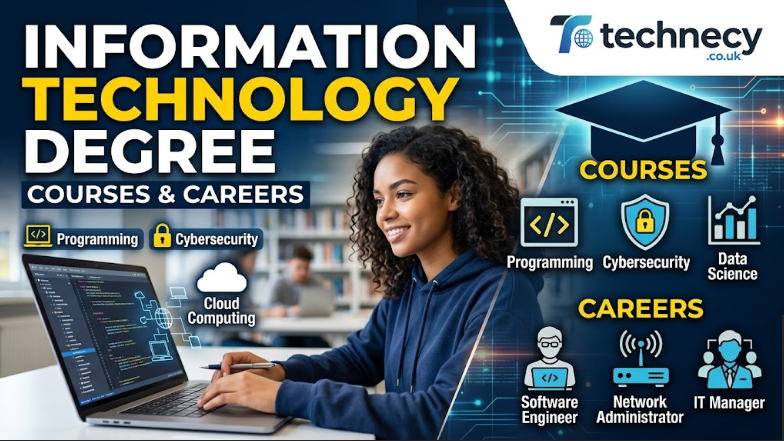
Technology supports almost every part of modern life, from online banking and healthcare systems to business operations and communication platforms. An Information Technology degree prepares students to manage these systems, solve technical problems, and help organizations use technology more effectively. Many students consider an IT degree because they want a career in technology but prefer practical applications over highly theoretical computer science topics. The field focuses on how businesses use hardware, software, networks, and digital services to operate efficiently. An IT education can open doors to careers in cybersecurity, cloud computing, network management, system administration, and technology consulting. However, success in this field depends not only on earning a degree but also on developing practical skills and staying updated with changing technologies.
What Is an Information Technology Degree?
An Information Technology degree is a program that teaches students how to design, manage, maintain, and secure computer systems used by organizations. The focus of IT is solving real-world technology challenges. Students learn how to support users, manage infrastructure, protect information, and improve business processes through technology. Unlike computer science, which often focuses on algorithms, advanced programming concepts, and computing theory, information technology is more focused on applying existing technologies to meet organizational needs. A typical IT program combines technical subjects with business knowledge, helping graduates understand both the technology itself and how companies depend on it.
What Do You Study in an Information Technology Degree Program?
IT programs usually cover a wide range of subjects because technology professionals need knowledge across multiple areas.
Computer Systems and Hardware
Students learn how computers, servers, storage devices, and other technology components work together. Understanding hardware helps IT professionals diagnose problems, maintain systems, and recommend suitable solutions. This foundation is important for anyone working in technical support, infrastructure management, or system administration.
Networking Fundamentals
Networks allow computers and devices to communicate with each other. IT students study how networks are designed, managed, and protected. Courses may cover topics such as internet protocols, network configuration, wireless technology, and troubleshooting. Networking knowledge is valuable because almost every organization depends on reliable digital communication.
Database Management
Organizations collect large amounts of information, and databases help store and organize that data. IT students learn about database structures, data management, security practices, and ways to retrieve information efficiently. These skills are useful for careers involving business systems, data administration, and application support.
Cybersecurity Principles
As cyber threats continue to affect businesses and individuals, security knowledge has become an important part of IT education. Students learn about protecting systems, managing access, reducing risks, and understanding common security issues. Those interested in cybersecurity can continue developing specialized skills through advanced courses and certifications.
Cloud Computing
Many companies now use cloud services to store data, run applications, and manage digital infrastructure. IT programs often introduce students to cloud concepts, including virtual environments, cloud storage, and service management. Cloud knowledge has become valuable for professionals working with modern business technology.
Different Types of Information Technology Degrees
Students can choose different levels of IT education depending on their career goals. An associate degree provides basic technical knowledge and can prepare students for entry-level positions such as support technician or junior network assistant. A bachelor’s degree offers deeper study of systems, security, databases, and technology management. It is one of the most common options for students seeking long-term IT careers. A master’s degree allows professionals to specialize further in areas such as cybersecurity, information systems management, or advanced technology leadership.
Career Options After an Information Technology Degree
An IT degree can lead to many career opportunities because organizations in almost every industry need technology professionals.
IT Support Specialist
IT support specialists help users solve computer, software, and system problems. This role is often a starting point for graduates who want to gain practical experience.
Systems Administrator
Systems administrators manage company servers, operating systems, accounts, and technical environments. They make sure essential systems remain available and secure.
Network Administrator
Network administrators maintain communication systems and monitor network performance. They help organizations keep employees connected and ensure reliable access to digital resources.
Cybersecurity Analyst
Cybersecurity analysts focus on protecting systems and information from security threats. They monitor risks, investigate suspicious activity, and help improve security practices.
Cloud Specialist
Cloud professionals help organizations manage online infrastructure and services. They work with cloud platforms, storage systems, and digital environments.
IT Project Manager
IT project managers combine technology knowledge with leadership skills. They coordinate teams, manage schedules, and help deliver technology projects successfully.
Skills That Help IT Graduates Succeed
A degree provides important knowledge, but employers often look for practical abilities as well.
Successful IT professionals usually develop skills such as:
- Problem-solving
- Communication
- Technical troubleshooting
- Networking knowledge
- Security awareness
- Cloud platform experience
- Basic programming skills
Hands-on experience through internships, personal projects, and certifications can make graduates more competitive in the job market.
Information Technology Degree vs Computer Science Degree
Information technology and computer science are closely related but serve different interests. IT focuses on managing and applying technology systems. It is a good fit for students who enjoy working with networks, security, infrastructure, and business technology solutions. Computer science focuses more on software development, algorithms, artificial intelligence, and theoretical computing concepts. Students interested in building software applications may prefer computer science, while those interested in managing technology environments may find IT a better match.
Is an Information Technology Degree Worth It?
An IT degree can be a valuable investment for students who want a flexible career in technology. Businesses, healthcare providers, financial institutions, and government organizations all need professionals who can manage digital systems. However, technology changes quickly. A degree should be viewed as a foundation rather than the final step. Continuous learning is important because new tools, security threats, and platforms appear regularly. Students who combine education with practical experience often have stronger career opportunities.
Future Opportunities in Information Technology
The IT field continues to expand as organizations adopt cloud services, automation, artificial intelligence tools, and stronger security systems. Future IT professionals will need to understand not only traditional computer systems but also emerging technologies that affect how businesses operate. The strongest career paths will likely belong to professionals who can combine technical knowledge with the ability to solve business problems.
Who Should Choose an Information Technology Degree?
An IT degree may be a good choice for people who enjoy technology, troubleshooting, and finding solutions to technical challenges. It is suitable for students who want a career working with computer systems but may not want to focus entirely on advanced software development or mathematical computing. Curiosity and willingness to keep learning are often just as important as technical ability in this field.
Conclusion
An Information Technology degree provides a practical foundation for entering the technology industry. It helps students understand how digital systems work and how organizations can use technology to solve everyday challenges. The field offers many career directions, from cybersecurity and cloud computing to networking and system management. The right combination of education, hands-on experience, and continuous learning can help graduates build long-term careers. For students who enjoy technology and problem-solving, information technology can be a path toward a wide range of professional opportunities.