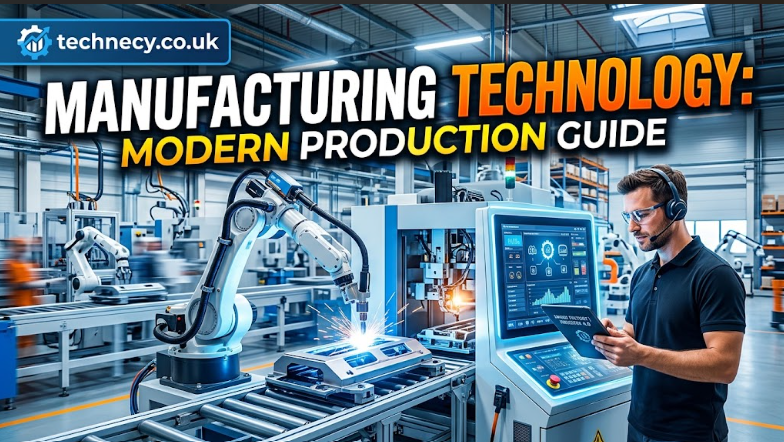
Manufacturing technology has become the foundation of how products are created, improved, and delivered across industries. From automobiles and medical equipment to electronics and consumer goods, companies rely on advanced production methods to meet higher expectations for speed, accuracy, and quality. The idea of manufacturing technology is no longer limited to machines inside a factory. It now includes digital systems, automated equipment, data analysis, and intelligent processes that help manufacturers make better decisions. These changes are allowing businesses to produce more efficiently while adapting to changing markets.
What Is Manufacturing Technology?
Manufacturing technology refers to the equipment, techniques, software, and processes used to convert raw materials into finished products. It includes both traditional production methods and modern digital solutions designed to improve manufacturing operations. A manufacturing system may involve machines that shape materials, software that manages production schedules, sensors that collect information, and automated tools that perform complex tasks. The purpose is to create products with better consistency while reducing unnecessary costs and errors. Modern manufacturing technology combines engineering knowledge with digital tools. This connection allows factories to monitor performance, identify problems, and improve processes based on real information rather than assumptions.
How Manufacturing Technology Has Developed
Manufacturing has continuously changed as new inventions have improved production methods. Early factories depended heavily on manual labor and basic machinery. The introduction of steam power changed production by allowing factories to increase output. Later, electricity and assembly lines created a new era of mass manufacturing. The arrival of computers introduced programmable machines and automated control systems. Manufacturers gained the ability to produce complex parts with greater precision. Today, many companies are moving toward smart manufacturing, where machines, software, and employees work together through connected systems. This approach allows factories to become more flexible and responsive.
Technologies Changing Modern Manufacturing
Automation and Robotics
Automation is one of the most important developments in manufacturing. It allows machines to complete repetitive or highly precise tasks with limited human involvement. Robots are commonly used for welding, assembly, packaging, inspection, and material handling. In industries such as automotive manufacturing, robots help maintain consistent quality while improving production speed. However, automation does not simply remove human involvement. Skilled workers are still needed to operate systems, maintain equipment, and solve complex production challenges.
Artificial Intelligence in Manufacturing
Artificial intelligence is helping manufacturers understand production data and make better decisions. AI systems can analyze information from machines to detect unusual patterns, predict possible equipment failures, and improve quality checks. Instead of waiting for problems to occur, manufacturers can take action earlier. For example, predictive maintenance allows companies to service equipment before a major breakdown interrupts production.
Industrial Internet of Things (IIoT)
Industrial Internet of Things technology connects machines, sensors, and software systems. These connected devices collect information about production activities and share it with management systems. Manufacturers use this data to track machine performance, monitor energy usage, and identify areas where improvements can be made. Connected factories provide better visibility because managers can understand what is happening throughout the production process.
CNC Machining
Computer Numerical Control machining uses computer instructions to control manufacturing equipment. These machines can cut, shape, and create detailed components with high accuracy. CNC technology is widely used in industries where precision is critical, including aerospace, automotive, and medical manufacturing. The main advantage of CNC machining is consistency. Once programmed correctly, machines can produce identical parts repeatedly with minimal variation.
3D Printing and Additive Manufacturing
Traditional manufacturing often removes material to create a product. Additive manufacturing works differently by building objects layer by layer. 3D printing allows engineers to create prototypes quickly and test designs before large-scale production. It is also useful for customized products and complex components that may be difficult to manufacture using traditional methods. Industries such as healthcare, aerospace, and product design are using this technology to create specialized solutions.
Why Manufacturing Technology Matters
Manufacturers operate in a competitive environment where efficiency and quality can determine success. Technology helps companies improve production while responding faster to customer needs. A factory with better monitoring systems can identify problems before they become expensive failures. A company using advanced design tools can develop products faster. Automated inspection systems can help maintain quality standards throughout production. The value of manufacturing technology comes from solving real business problems, not simply adding new equipment.
Benefits of Manufacturing Technology
One major benefit is improved efficiency. Automated systems can increase production capacity and reduce delays caused by manual processes. Quality improvement is another important advantage. Digital monitoring and precise machines help manufacturers maintain consistent results and reduce defects. Technology can also lower waste by helping companies use materials and energy more effectively. Better production planning allows businesses to avoid unnecessary costs. Safety is another area where technology provides value. Machines can handle dangerous tasks involving heavy materials, extreme temperatures, or hazardous environments.
Challenges Manufacturers Need to Consider
Although advanced technology offers many advantages, adoption is not always simple. The cost of new equipment, software, and employee training can be a challenge, especially for smaller manufacturers. Companies need careful planning to ensure technology investments provide measurable benefits. Cybersecurity has also become a major concern. Connected manufacturing systems create new opportunities for efficiency, but they also require strong protection against digital threats. Another challenge is workforce development. Employees need new technical skills to manage automated equipment, analyze data, and work alongside advanced systems.
Manufacturing Technology Across Different Industries
Manufacturing technology supports many sectors around the world. Automotive companies use automation and robotics to build vehicles more efficiently. Aerospace manufacturers depend on precision equipment to create complex aircraft components. Medical companies use advanced production methods to develop specialized devices and implants. Electronics manufacturers rely on highly accurate systems because modern devices require extremely small and precise components. Each industry applies technology differently based on its production needs and customer requirements.
The Future of Manufacturing Technology
Manufacturing will continue becoming more connected and intelligent. Future factories are expected to use more advanced robotics, artificial intelligence, and real-time data systems. Sustainability will also become an important focus. Manufacturers are looking for ways to reduce energy consumption, minimize waste, and create more environmentally responsible production methods. The next stage of manufacturing will not only focus on producing faster. It will focus on creating smarter systems that can adapt, improve, and support better decision-making.
Conclusion
Manufacturing technology has changed production from a simple mechanical process into a connected and intelligent system. Companies today use advanced tools to improve efficiency, maintain quality, and compete in demanding markets. The most effective approach is not adopting technology for its own sake. Successful manufacturers choose solutions that match their goals and solve specific operational challenges. As technology continues to develop, manufacturing will become more flexible, efficient, and capable of producing higher-quality products with fewer resources.