Introduction
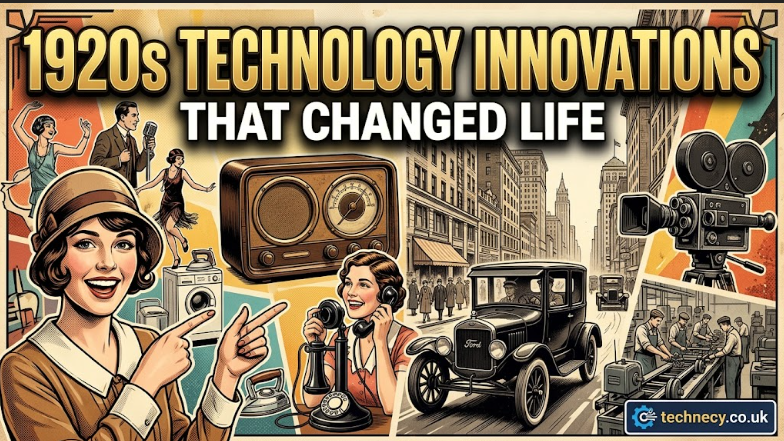
The 1920s was a decade of remarkable technological change. After the disruption of World War I, industries expanded, scientific research accelerated, and new inventions began reaching ordinary households. Technology was no longer limited to factories, laboratories, or wealthy individuals; it became part of everyday life. From the radio sitting in a family living room to automobiles filling city streets, the decade introduced a new relationship between people and machines. Many technologies that shaped the twentieth century either appeared during this period or became widely adopted in the 1920s.
How Technology Changed During the 1920s
The 1920s was a period when production methods improved and consumer demand increased. Companies discovered faster ways to manufacture products, making many items more affordable. This helped transform inventions into practical tools used by millions of people. Electricity also became more common in homes and businesses, creating opportunities for new household devices. People began expecting technology to save time, provide entertainment, and make daily tasks easier.
Radio Became the Voice of a New Generation
Radio was one of the most influential technologies of the 1920s. Before radio became popular, people mainly received information through newspapers, letters, and public events. Broadcasting changed that by allowing news, music, and entertainment to enter homes instantly. Families often gathered around their radios in the evening to listen to programs together. Sports events, political speeches, comedy shows, and musical performances could reach large audiences at the same time. The growth of radio also created new industries. Broadcasting companies, advertisers, and electronics manufacturers expanded rapidly as more people purchased radio sets.
Automobiles Transformed Everyday Transportation
The automobile industry experienced major growth during the 1920s. Improvements in factory production made cars cheaper and easier to produce, allowing more middle-class families to own vehicles. The popularity of automobiles changed society in several ways. People could travel farther for work, shopping, and leisure. Roads expanded, service stations appeared, and businesses developed around car ownership. Cars also influenced where people lived. Suburban communities began growing as transportation became more convenient, reducing dependence on living close to city centers.
Television Technology Began Its Early Development
Television was not yet a common household product in the 1920s, but important experiments took place during the decade. Inventors worked on ways to transmit moving images through electronic signals. Early television systems were limited compared with modern technology, but they proved that visual broadcasting was possible. These experiments created the foundation for the television industry that would become popular in later decades. The 1920s represented the beginning of a new idea: entertainment and information could be delivered directly into people’s homes through technology.
Aviation Reached New Heights
Aircraft technology improved significantly during the 1920s. Planes became safer, more reliable, and capable of longer flights. Aviation moved beyond military use and began developing into a form of civilian transportation. One of the most memorable events of the decade was Charles Lindbergh’s solo nonstop flight across the Atlantic Ocean in 1927. His achievement captured global attention and demonstrated the future possibilities of air travel. The decade helped establish aviation as an important part of modern transportation and international connection.
Movies Entered the Sound Era
The film industry experienced a major technological shift during the late 1920s. For years, audiences watched silent films accompanied by live music, but new sound-recording methods changed cinema. Films with synchronized sound introduced a completely different movie experience. Actors could now speak on screen, and filmmakers gained new ways to tell stories. The success of early sound films transformed Hollywood and changed the future direction of entertainment.
Electrical Appliances Improved Home Life
Electricity changed the way people managed their homes during the 1920s. A growing number of households adopted appliances designed to reduce manual work and improve convenience. Refrigerators helped preserve food for longer periods, washing machines reduced household labor, and vacuum cleaners made cleaning easier. These products reflected a broader movement toward modern living. Technology became associated not only with industry but also with comfort and efficiency inside the home.
Medical Advances Improved Healthcare
The 1920s brought important progress in medical science. One of the most significant developments was the successful use of insulin as a treatment for diabetes in 1922. Another major discovery came in 1928 when Alexander Fleming identified penicillin’s antibacterial properties. Although widespread use came later, the discovery eventually changed the treatment of bacterial infections. These medical achievements showed how scientific research could create solutions that improved and extended human life.
Early Rocket Experiments Started a New Scientific Direction
Rocket development was still in its early stages during the 1920s, but researchers began exploring the possibilities of space travel. American scientist Robert Goddard successfully tested the first liquid-fueled rocket in 1926. At the time, few people understood the future importance of this work, but his experiments later influenced aerospace engineering. The research conducted during this period became an early step toward future space exploration.
Technology and the Changing Lifestyle of the 1920s
The biggest impact of 1920s technology was not just the inventions themselves but how they changed people’s habits. Families consumed information differently, traveled differently, and spent their free time in new ways. Technology created a faster and more connected society. People experienced entertainment at home, traveled more easily, and gained access to products that previous generations could not imagine owning.
The Lasting Influence of 1920s Technology
Many technologies from the 1920s continued developing throughout the twentieth century. Radio evolved into modern broadcasting, early television experiments became global media networks, and automobile production methods influenced manufacturing worldwide. The decade showed that technology could become part of everyday culture. It was a period when inventions stopped being rare achievements and started becoming normal parts of life.
Conclusion
The technology of the 1920s marked a turning point in modern history. It was a decade when inventions moved beyond laboratories and factories to become part of everyday experiences. Radio, automobiles, aviation, household appliances, and medical discoveries changed how people lived and interacted with the world. These developments created patterns of technology use that continued throughout the twentieth century. The 1920s remains an important period because it introduced a more connected, mobile, and technology-focused society that shaped the future.